

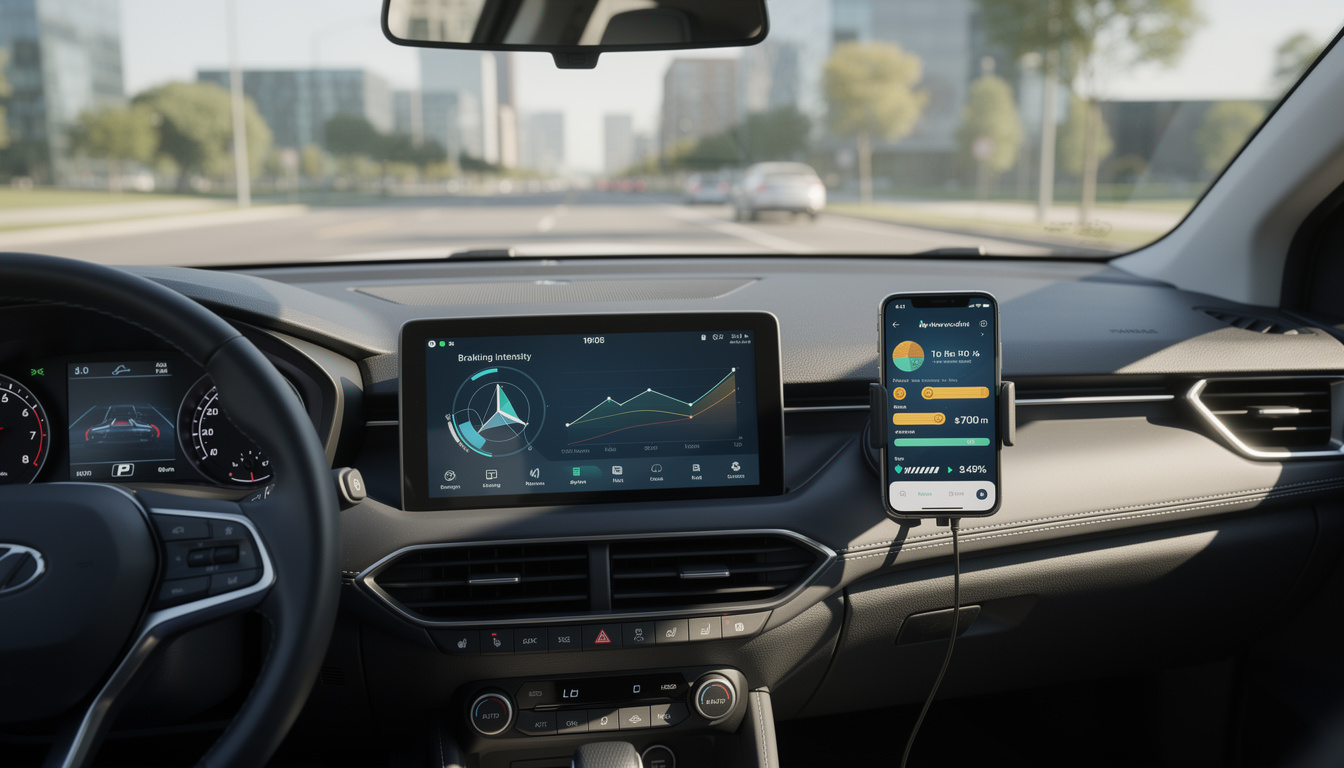
A driver paying $1,500 a year for full coverage can shave off $300 to $600 with the right telematics program. That’s the sales pitch, and for some people it holds up. Progressive Snapshot, State Farm Drive Safe & Save, Allstate Drivewise, GEICO DriveEasy, and Nationwide SmartRide all promise lower insurance rates if your driving behavior looks better than the insurer’s default assumptions about your age, ZIP code, and vehicle.
But telematics isn’t a free discount. It’s driver monitoring tied to pricing, and the wrong profile can get little savings or even a higher renewal bill. If you drive under 10,000 miles a year, avoid midnight trips, and don’t brake like Manhattan traffic is trying to kill you, usage-based insurance can work. If you’re a night-shift nurse, a heavy commuter, or you care a lot about vehicle tracking and data sharing, the tradeoff gets harder fast.
How telematics and pay-how-you-drive pricing change auto insurance 2026
Traditional car insurance still leans on group pricing. You’re charged based on broad risk assessment factors like age, claims history, car type, territory, and, in many states, credit-based insurance scoring. Telematics changes that by adding actual trip data. An app or plug-in device records speed patterns, hard braking, mileage, time of day, and sometimes phone motion during trips, then adjusts your premium at renewal.
The big selling point is obvious: if you’re safer than the average driver in your rating bucket, you finally get credit for it. A 22-year-old with a clean record usually pays more than a 45-year-old with the same record because insurers price age bands, not personal discipline. Telematics gives that younger driver a shot at proving lower risk.
There are two branches here, and buyers often mix them up. Pay-how-you-drive uses behavioral data like braking and night driving. Pay-per-mile or pay-how-you-drive hybrids lean much more heavily on total miles. Nationwide SmartMiles and other mileage-based programs can beat standard telematics for a driver who barely uses the car. California is the clearest example of a state exception: traditional behavioral telematics pricing is restricted there, but pay-per-mile options remain available and often make more sense for low-mileage households.
In California, Hawaii, Massachusetts, Michigan, and Washington, credit-based insurance scoring is banned or heavily restricted for auto coverage. That’s one reason behavior-based pricing appeals to insurers and some shoppers alike. It creates another pricing lever that doesn’t depend on your financial history.
That doesn’t make telematics automatically fair. It can still punish people whose work schedules or driving environment look riskier on paper. Urban stop-and-go traffic produces more hard-braking events, even for attentive drivers. That’s why the best use of telematics is selective, not universal.
What the apps and devices actually track
Most major programs use either a smartphone app or an OBD-II plug-in device under the dashboard. Progressive Snapshot and some State Farm setups use plug-in hardware in certain vehicles and states, while Allstate Drivewise and GEICO DriveEasy lean heavily on app-based tracking. Built-in connected-car systems are expanding too, especially in newer vehicles.
Across carriers, the core metrics are similar: sustained high speed, rapid acceleration, hard braking, trip mileage, and late-night driving. Some programs now add phone distraction signals, cornering, following distance, or lane-deviation style indicators fed through AI scoring models. That’s where auto insurance 2026 starts looking less like a blunt rating system and more like continuous surveillance with a discount attached.
Which telematics programs offer real cost savings and which ones carry surcharge risk
The headline discounts are attractive, but the fine print matters more. Safe drivers can see 10% to 40% off at renewal. Most programs also give a participation discount of roughly 5% to 10% just for enrolling, though the structure varies by insurer. The catch: some carriers reserve the right to surcharge poor performers.
That’s the dividing line shoppers should care about first. A telematics program with upside only is much safer to try than one that can raise your premium after six months of tracking.
| Program | Tracking method | Published top discount | Rate increase risk | Best fit |
|---|---|---|---|---|
| Progressive Snapshot | App or OBD-II device | Up to 30% | Yes, in many states | Drivers confident about braking, mileage, and trip timing |
| State Farm Drive Safe & Save | App and/or connected setup | Up to 30% | No published surcharge model | Low-mileage drivers who want less downside |
| Allstate Drivewise | Smartphone app | Up to 40% | Possible in some filings | Drivers with smooth habits and predictable daytime use |
| GEICO DriveEasy | Smartphone app | Up to 25% | Varies | Drivers who want trip-by-trip feedback |
| Nationwide SmartRide | App, device, or connected car | Up to 40% | No | Cautious shoppers who want discount upside without a penalty |
| Nationwide SmartMiles | Mileage-based | Varies by miles driven | No behavior surcharge | Very low-mileage households under about 7,000 miles yearly |
Here’s the blunt view: Progressive Snapshot can save real money, but it’s not the beginner-friendly option if you’re unsure about your habits. Around one in five participants may see a rate increase based on driving data in some public summaries. State Farm and Nationwide are easier recommendations because they don’t lean as hard on surcharge risk. That’s not charity. It’s a better consumer product.
Allstate’s published maximum looks great, but city drivers should read that offer skeptically. Hard braking carries heavy weight in many scoring models, and dense traffic can turn ordinary defensive driving into a bad score. If your commute runs through Boston, Atlanta, or downtown Chicago, the theoretical 40% savings may be less relevant than the practical chance of getting judged by bad context.
If you’re comparing carriers more broadly, it helps to read telematics next to your base policy choices. A discount on a weak liability setup isn’t much of a bargain. Start with a solid coverage framework, then see whether behavior pricing helps. InsuranceProFinder’s guide to full coverage auto insurance and its breakdown of how to compare car insurance quotes are the right place to sanity-check the bigger picture.
What driving behavior helps or hurts your score the most
Hard braking is usually the biggest score killer. Insurers often define it as a deceleration of about 7 to 8 mph per second. That’s not a casual stop at a red light. It’s the kind of sudden braking that suggests tailgating, distraction, or reactive driving. Drivers who cut these events sharply between one monitoring period and the next tend to get the best renewal savings.
Late-night driving is next. Trips between midnight and 4 a.m. are penalized because crash rates during those hours run roughly three to four times higher than daytime periods. That’s actuarially logical and socially clumsy. It means telematics can punish the exact workers who keep hospitals, warehouses, and airports running.
Mileage matters too, but not in the simplistic way people think. Driving less than 10,000 miles a year usually helps. Driving less than 7,000 can make a mileage-based plan better than a standard usage-based insurance program. But low mileage alone won’t save you if your trips include constant hard stops, fast acceleration, and repeated overnight runs.
- Best candidate: under 10,000 miles yearly, mostly daytime trips, low hard-braking frequency, little phone movement while driving
- Borderline candidate: moderate mileage, some city traffic, occasional overnight driving, mixed braking habits
- Poor candidate: more than 15,000 miles yearly, regular midnight-to-4 a.m. driving, dense urban commuting, aggressive acceleration
One detail many buyers miss: app-based systems may misread who is driving unless trips are corrected in the app. If your spouse borrows your car or you’re a passenger in someone else’s vehicle, bad trip attribution can drag down your score unless you review and recategorize rides. That’s tedious, but it affects dollars.
Another overlooked issue is distraction scoring. Some apps don’t read your texts or calls, but they do measure phone motion as a proxy for handling the device. That means a phone sliding off a seat, getting bumped in a cup holder, or being picked up by a passenger can still register badly. The model isn’t always smart enough to know what really happened.
Who should skip telematics altogether
Telematics is a bad fit for more people than insurers admit. Night-shift workers are the clearest example. If your schedule forces driving during the riskiest hours, your score starts with a handicap you can’t fix. That’s not a personal failing. It’s a rating model problem.
Heavy commuters should be cautious too. More time on the road means more chances for hard braking, congestion, and odd app readings. Privacy-focused drivers should probably skip it as well. If you’re uneasy about sharing trip-level data to lower your bill by $15 to $25 a month, your instinct is reasonable.
Parents adding a teen driver are a more mixed case. Telematics can help because teen premiums are brutal and behavior coaching can work. Consumer survey data has shown median savings around $245 a year for policies with young drivers. But parents should make sure the carrier doesn’t use poor scores to turn a painful premium into a worse one.
Privacy, data sharing, and why telematics became a legal mess
The money side of telematics is straightforward. The privacy side isn’t. Your insurer or its vendor may collect trip time, mileage, GPS pathing, speed patterns, braking, and device motion. Some systems have recorded location points as often as every few seconds. Insurers say this supports pricing and safety. Critics say it created a consumer data market that outgrew consent.
By 2025 and 2026, that concern stopped sounding theoretical. The FTC’s consent order against GM and OnStar put connected-car data practices under a federal spotlight after allegations of extensive geolocation collection and sharing without meaningful consent. Texas sued Allstate and Arity over alleged unlawful collection and sale of driving data affecting tens of millions of Americans. An Illinois federal class action tied to cellphone tracking allegations against Allstate was allowed to proceed in 2026. Those cases changed the tone of the market. Driver monitoring stopped looking like a harmless loyalty perk.
That’s why the lazy advice to “just try the app” is no longer good enough. Before you enroll, you should know whether the carrier shares data with third parties, whether deletion is available, whether the data can be used beyond underwriting, and whether the app draws from your phone only or also from the car’s built-in systems.
State law matters here. Oregon’s 2025 privacy update extended coverage to motor vehicle manufacturers and affiliates processing data from vehicle use, including telematics shared with insurers. North Carolina has pushed written notice and consent requirements. New York lawmakers have proposed disclosure rules around discount methodology. Federal law still hasn’t produced a broad telematics privacy framework, so shoppers are left piecing together rights state by state.
One more consumer trap: connected vehicles may share data even if you never sign up for an insurer’s telematics discount. If your car has built-in connected services, your data trail may start with the manufacturer, then move through vendors like LexisNexis or Verisk, and eventually shape quotes elsewhere. If you want a primer on how insurers evaluate more than just your application answers, InsuranceProFinder’s coverage of CLUE reports and claim history is worth reading next.
What telematics usually does not track
Despite the surveillance problem, insurers don’t typically record your phone calls or audio. They also don’t directly change your credit score, and telematics discounts operate separately from credit-based pricing. In states where credit scoring is banned for auto underwriting, behavior-based systems still function because they’re based on trip data rather than financial history.
That said, “doesn’t record audio” is a low bar for comfort. The real issue is whether insurers or vendors can infer patterns from route timing, repeated destinations, work hours, and driving habits. A map of your life doesn’t need your microphone to be intimate.
How to decide if telematics is worth it before your next renewal
Run the math before you grant access. If your annual premium is $1,800 and a realistic discount is 15%, that’s $270 a year. Good, but not life-changing. If the same program can surcharge 10% to 15% for weak scores, your downside is $180 to $270. That’s not a trial. That’s a wager.
The best candidates are easy to spot: low-mileage daytime drivers with smooth habits and a high current premium. The best first programs are the ones with no telematics-based rate increase, especially Nationwide SmartRide, State Farm Drive Safe & Save, and USAA SafePilot for military households. If you’re unsure, start there.
There’s also a bigger editorial point. Telematics is better than demographic pricing only when it gives consumers a fair way to prove lower risk. When it turns unavoidable work schedules, city traffic, or opaque data sharing into a penalty, it’s just old underwriting with a smartphone attached. The industry likes to call that personalization. Buyers should call it what it is: selective repricing.
If you’re shopping now, compare the telematics option against standard quotes from carriers that already price you competitively without constant tracking. Shopping every two to three years still matters because loyalty discounts rarely offset renewal creep of 15% to 30%. You can start with the broader quote-shopping tools and carrier breakdowns on InsuranceProFinder, then review related guidance on auto insurance discounts that actually matter before you give any app six months of your driving data.
Before you enroll, check the declarations page, confirm whether the telematics program can raise rates, ask how long data is stored, and see whether deleting the app actually ends collection.
Nothing in this article is personalized insurance advice. State laws, policy language, and your own risk profile matter. Before you buy, bind, or cancel a policy, talk to a licensed agent or independent broker in your state.